
Over the past few years, the NDIS sector has begun shifting into a very different phase from the rapid expansion period many providers experienced early on.
For a long time, many organisations were able to grow primarily through referrals, local reputation, support coordinator relationships and word of mouth. In many regions, demand significantly outweighed supply, and simply being known within the local community was often enough to maintain steady enquiry flow.
That environment is gradually changing.
Across the sector, providers are now experiencing increasing pressure around compliance, operational expectations, participant funding scrutiny, registration requirements and competition. At the same time, larger organisations, technology platforms and consolidated provider ecosystems are becoming increasingly influential throughout parts of the market.
This has naturally created concern among many providers.
Some fear that smaller providers may eventually struggle to compete. Others are hearing rumours that platforms or large organisations are “taking over” the sector altogether.
While much of that commentary is exaggerated, there is a very real shift occurring across the NDIS landscape, and providers who understand these changes early are likely to place themselves in a significantly stronger position over the coming years.
Importantly, this does not mean the NDIS is disappearing, nor does it mean independent providers cannot continue thriving.
However, it does likely mean that professionalism, visibility, trust and digital presence are going to matter far more moving forward than they did during the earlier growth years of the scheme.
The NDIS Is Maturing As An Industry
What we are seeing across the NDIS is not unusual.
Almost every rapidly growing industry eventually moves through a similar transition:
- early rapid expansion
- increasing competition
- stronger regulation
- higher operational expectations
- growing digital influence
- and eventually some level of consolidation.
Real estate, healthcare, finance, accounting and aged care have all experienced similar shifts over time.
The NDIS now appears to be entering that more mature stage of evolution.
Many of the changes providers are seeing today are not isolated events. They are part of a broader long-term movement toward:
- greater accountability
- stronger safeguarding
- increased transparency
- more structured operations
- and more sophisticated market infrastructure.
Importantly, these changes are not occurring all at once.
Some reforms have already been implemented, while others are continuing to roll out progressively over the coming years. This is why many providers currently feel uncertainty around where the market is heading and what the future may look like for smaller organisations.
At the same time, participants and families are becoming more informed and more selective.
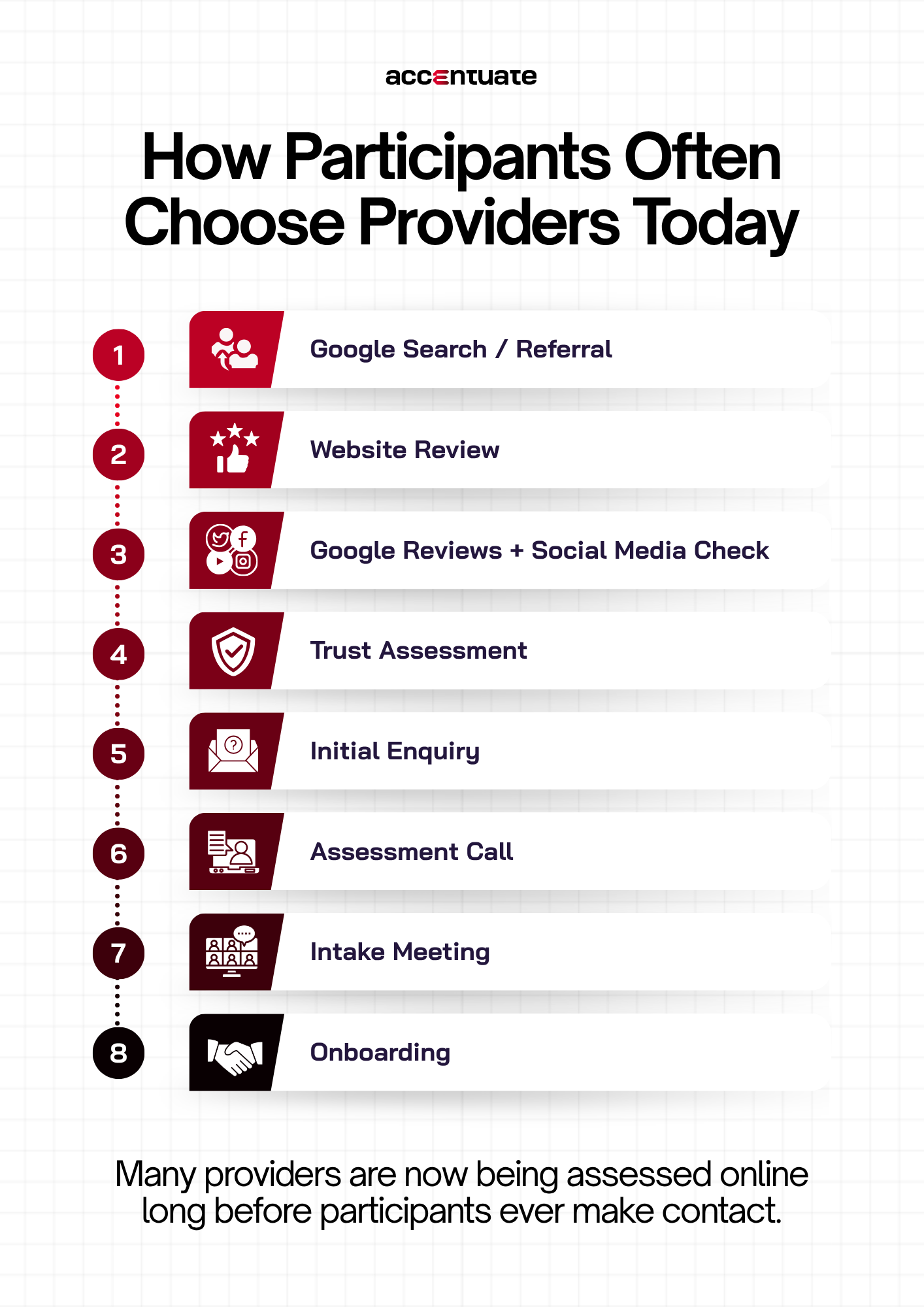
Years ago, many participants relied heavily on referrals from support coordinators or local networks when choosing providers. Today, participants and families are increasingly researching providers independently online before making contact.
In many cases, they are:
- comparing multiple providers
- reviewing websites
- reading Google reviews
- checking social media presence
- assessing professionalism
- and trying to determine who feels trustworthy and established.
That shift alone is changing how providers need to think about growth and visibility moving forward.
“The providers most at risk are often not necessarily the smallest providers. They are the providers who remain invisible.”
Why Consolidation Is Increasing
One of the clearest trends emerging across the sector is consolidation, particularly around:
- plan management
- software systems
- participant marketplaces
- provider platforms
- and digital infrastructure.
As compliance requirements, administrative overhead and operational complexity increase, larger organisations are often able to scale more efficiently through technology, automation and centralised systems.
Meanwhile, many smaller operators across these areas are finding it increasingly difficult to keep pace with rising operational demands.
This is where much of the current industry discussion around companies like Kismet and other large platforms is coming from.
As larger organisations continue acquiring plan managers, support networks and infrastructure across parts of the ecosystem, many providers are naturally asking:
“What does this mean for independent providers?”
The answer is probably not that smaller providers disappear.
However, it likely does mean that providers who fail to evolve professionally may gradually become less visible and less competitive over time.
Importantly, consolidation does not necessarily eliminate competition.
In many industries, consolidation actually increases the importance of branding, trust and independent visibility.
Providers who rely entirely on referral relationships or legacy word-of-mouth may eventually find themselves exposed if those channels become less predictable or increasingly controlled by larger ecosystems.
Meanwhile, providers who build strong independent visibility and direct trust with participants and families are often far more resilient long-term.
This is likely one of the most important strategic shifts many providers will need to understand over the coming years.
The RealEstate.com.au Effect
One of the easiest ways to understand what may happen next in the NDIS sector is to look at how industries like real estate evolved.
Years ago, many real estate agencies relied heavily on local reputation, referrals, newspaper advertising and community relationships. Then platforms like realestate.com.au fundamentally changed how people discovered properties and agents.
Importantly, real estate agents did not disappear.
However, the market changed dramatically.
Agencies with stronger branding, better presentation, professional websites, stronger reviews and clearer positioning adapted significantly better than agencies that failed to modernise.
The same pattern is likely to continue emerging across the NDIS sector.
As larger platforms and organisations continue consolidating parts of the ecosystem, participants and families will still continue making decisions based on trust, confidence and perceived professionalism.
They will still search Google.
They will still compare providers online.
They will still read reviews.
They will still assess websites and social media presence before making contact.
In fact, these things may become more important than ever as larger organisations begin capturing larger portions of the referral chain and participant discovery process.
This is where many providers may underestimate what is changing.
The providers most at risk are often not necessarily the smallest providers.
They are the providers who remain invisible.
A provider may deliver exceptional support, genuinely care about participants and have highly experienced staff, but if their digital presence appears outdated, inconsistent or difficult to trust, participants may never even reach out in the first place.
Meanwhile, providers with strong branding, modern presentation and visible community presence may naturally attract significantly more trust and enquiry flow over time.
Why Digital Presence Is Becoming Increasingly Important
Many providers still think of their website as little more than an online brochure.
In reality, a provider’s digital presence is increasingly becoming:
- their first impression
- a trust-building tool
- a credibility signal
- and often the deciding factor in whether a participant or family reaches out.
Today, participants and families commonly research multiple providers online before making contact. They compare:
- reviews
- branding
- professionalism
- communication style
- website quality
- and overall presentation.
A provider delivering excellent support may still unintentionally appear less established if their online presence feels outdated, inconsistent or difficult to navigate.
This is one of the reasons many providers are now investing more heavily into professional websites, stronger branding and participant-focused online experiences.
Importantly, this is not about appearing overly corporate.
Many participants actively prefer smaller providers who feel more genuine, personalised and community-focused.
However, participants and families still want confidence that a provider is:
- trustworthy
- organised
- professional
- responsive
- and established.
A modern digital presence helps communicate those qualities long before a conversation even occurs.
The Difference Between Good Care And Perceived Trust
One of the biggest shifts occurring across the sector is that providers are no longer judged solely on the quality of support they deliver internally.
They are increasingly judged on what participants and families can see externally.
This creates an important distinction between:
- good care
- and perceived trust.
A provider may genuinely deliver exceptional outcomes for participants, however if their online presence feels:
- outdated
- inconsistent
- inactive
- confusing
- or unprofessional
participants may subconsciously feel less confident reaching out.
Meanwhile, another provider with:
- clearer branding
- stronger reviews
- modern presentation
- quality photography
- educational content
- and active community presence
may immediately feel safer and more trustworthy to a participant or family researching online.
This does not necessarily mean the second provider delivers better support.
However, perception heavily influences trust.
And trust heavily influences enquiries.
This is particularly important in disability services because participants and families are often making deeply personal decisions involving:
- safety
- wellbeing
- vulnerability
- and long-term relationships.
People naturally look for reassurance before making contact.
That reassurance increasingly comes from:
- branding
- reviews
- presentation
- communication quality
- and digital presence.
“Good support alone is no longer always enough if participants cannot confidently discover or assess your organisation online.”
Google Reviews And Trust Signals May Become Even More Important
One area many providers still underestimate is the growing importance of trust signals.
As the market becomes more competitive and more digital, participants and families are increasingly looking for reassurance before engaging a provider.
This is where areas such as:
- Google reviews
- testimonials
- participant success stories
- branding consistency
- quality photography
- active social media presence
- and educational content
can begin playing a major role in shaping perception.
Many providers still have:
- very few reviews
- outdated Facebook pages
- inconsistent branding
- or websites with little trust-building content.
Meanwhile, participants are often comparing these providers against organisations that appear significantly more active, established and trustworthy online.
Even something as simple as:
- recent reviews
- updated imagery
- clear communication
- or active community content
can dramatically influence how trustworthy a provider feels to a participant or family researching online.
This is one of the reasons many providers are now placing increasing focus on:
- digital visibility
- online reputation
- and long-term brand positioning.
How Participants Actually Choose Providers Today
Many providers still assume participants primarily choose providers through referrals alone.
In reality, participant behaviour has changed significantly over recent years.
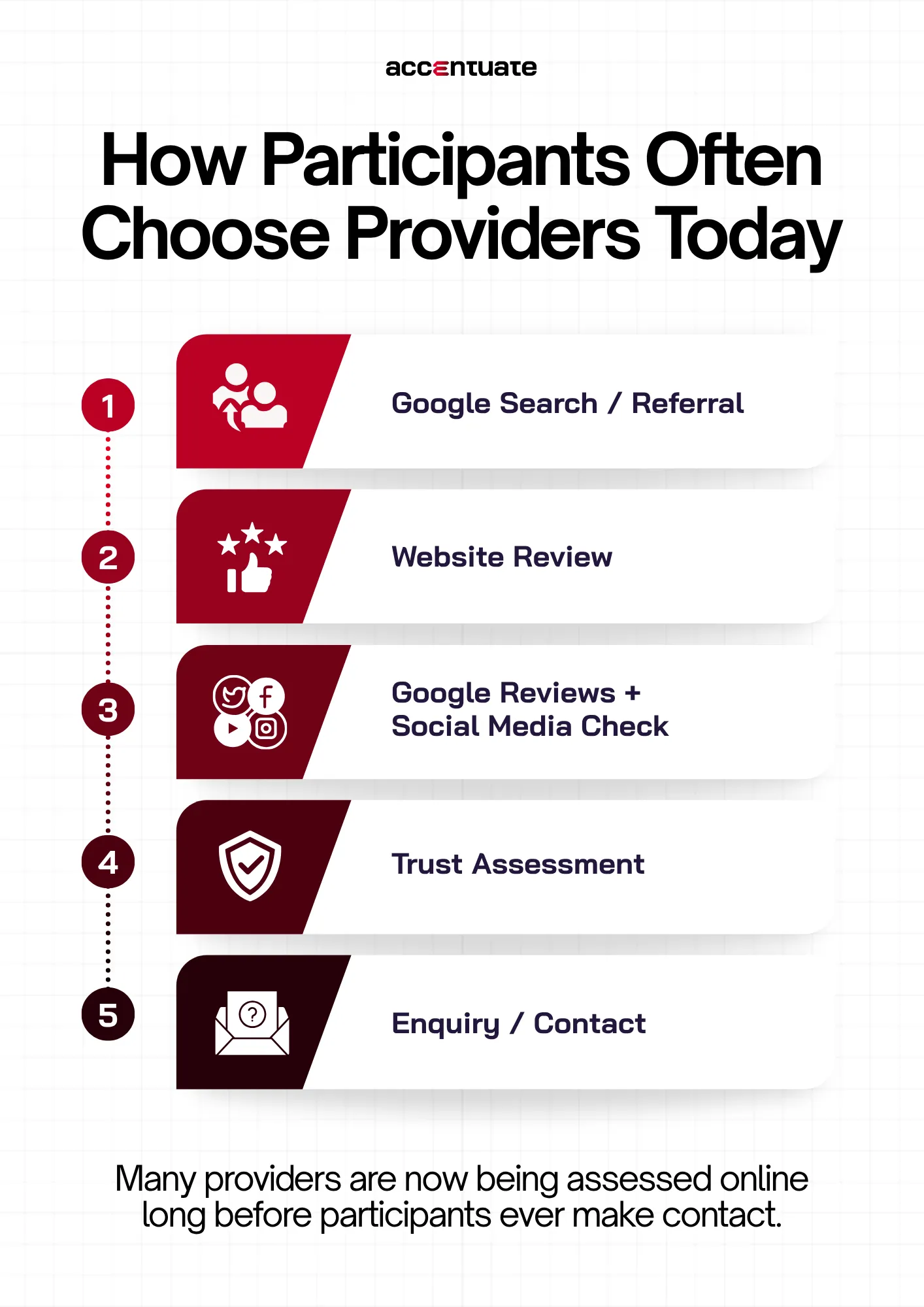
Today, many participants and families will:
- search online first
- compare multiple providers
- review websites and social media
- check Google reviews
- and quietly form opinions long before ever making contact.
In many cases, providers are being ruled out before they even realise they were being considered.
For example:
- a slow-loading website may create frustration
- inactive social media may create uncertainty
- poor branding may reduce trust
- missing reviews may create hesitation
- outdated information may signal disorganisation.
Meanwhile, providers who appear:
- active
- professional
- responsive
- and trustworthy
often create significantly stronger confidence immediately.
Participants are not simply choosing services.
They are choosing people and organisations they feel safe trusting.
This is one of the reasons providers who invest into:
- stronger branding
- professional websites
- active communication
- and community visibility
are often positioning themselves far more effectively long-term.
“Visibility creates familiarity. Familiarity creates trust. Trust drives enquiries.”
Referral-Only Growth Is Becoming Riskier
Historically, many providers have relied heavily on:
- support coordinators
- word of mouth
- plan managers
- and existing referral relationships.
Those channels will likely remain valuable for a long time.
However, providers relying entirely on referrals may become increasingly vulnerable as the market evolves.
As larger ecosystems consolidate and competition increases, referral flow may become:
- less predictable
- more competitive
- and increasingly influenced by larger networks and platforms.
This is one of the reasons many providers are beginning to focus more seriously on building direct visibility and participant acquisition systems.
Not aggressive sales systems.
But sustainable systems that help providers:
- stay visible within their local communities
- educate participants and families
- build trust consistently
- and generate ongoing enquiries independently.
This includes areas such as:
- local SEO
- Google reviews
- educational content
- social media visibility
- community campaigns
- participant-focused websites
- and long-term digital outreach.
Why Smaller Providers Can Still Compete Extremely Well
One of the biggest misconceptions currently circulating throughout the sector is the idea that only large providers will survive moving forward.
In reality, many smaller providers may continue to perform exceptionally well.
Smaller organisations often have major advantages:
- stronger participant relationships
- greater flexibility
- more personalised support
- stronger community connection
- and more authentic participant experiences.
Those qualities matter enormously.
In fact, many participants actively prefer providers who feel:
- approachable
- community-focused
- responsive
- and genuinely invested in participant outcomes.
However, smaller providers who fail to modernise their visibility and presentation may increasingly struggle to compete against organisations that communicate trust and professionalism more effectively online.
Good support alone is no longer always enough if participants cannot confidently discover or assess your organisation in the first place.
This is especially important for providers who still rely on:
- outdated websites
- minimal branding
- inactive social media
- or inconsistent presentation.
Many providers unintentionally appear far smaller or less established online than they actually are.
Meanwhile, providers who invest into:
- professional presentation
- branding consistency
- quality websites
- active online presence
- and community visibility
often create significantly stronger trust before a participant even makes contact.
What The Strong Providers Of The Future Will Likely Look Like
Over the coming years, the providers likely to remain strongest are probably not simply the biggest providers.
They are likely to be the providers who become:
- highly trusted
- highly visible
- professionally presented
- and deeply connected to their communities.
In many cases, the strongest providers of the future will likely have:
- modern participant-focused websites
- strong Google reviews
- consistent branding
- active social media presence
- educational content
- strong community visibility
- fast response times
- and sustainable enquiry systems.
Importantly, none of this replaces good support.
It amplifies it.
Providers delivering excellent participant outcomes while also building strong visibility and trust are likely to place themselves in an exceptionally strong long-term position as the sector continues evolving.
The Providers Who Adapt Early May Be Best Positioned For The Future
The NDIS sector is not collapsing.
But it is evolving rapidly.
And while some of these changes may create challenges, they also create enormous opportunity for providers willing to adapt early.
Over time, the market is likely to continue rewarding providers who:
- build strong trust within their communities
- maintain professional digital presence
- communicate clearly
- stay visible
- and create sustainable independent enquiry flow.
Importantly, providers do not need to become massive corporate organisations to succeed.
But they will likely need to ensure their:
- branding
- digital presence
- visibility
- communication
- and participant experience
continue evolving alongside the changing market around them.
Providers looking to strengthen their digital presence and long-term visibility can learn more here: